Casey’s Stock Analysis: Strong Q1 Earnings Support Growth Strategy, but Margin Pressure Remains
Casey’s Stock Analysis: Strong Q1 Earnings Support Growth Strategy, but Margin Pressure Remains
Casey's General Stores (NASDAQ: CASY) started fiscal 2027 on a strong note, delivering solid revenue and earnings growth while continuing to execute its newly launched three-year strategic plan. The company’s first-quarter results showed particularly strong profitability growth, supported by prepared food, fuel margin, and continued store expansion.
Q1 F2027 Performance
For the three months ended July 31, 2026, Casey’s generated $5.68 billion in total revenue, an increase of 24.3% from $4.57 billion a year earlier. The increase was helped by the integration of acquired stores, including the Fikes acquisition, as well as continued expansion of the company’s store network.
Gross profit increased from $1.11 billion to $1.24 billion, but gross margin declined to 21.8% from 24.4%.
Operating expenses also increased 8.0% to $754.1 million. The increase was partly related to Casey’s larger store base, higher credit card fees, employee costs, and insurance expenses.
Profitability improved substantially. Net income rose 27.1% to $273.7 million, while diluted earnings per share increased 27.7% to $7.37, compared with $5.77 in the prior-year quarter. EBITDA increased 17.1% to $485.1 million.
As of July 31, 2026, the company had approximately $1.4 billion of available liquidity, consisting of $524 million in cash and cash equivalents and approximately $857 million in available borrowing capacity. Total debt stood at approximately $2.43 billion.
During the quarter, Casey’s generated $384.1 million in operating cash flow and spent $194.4 million on property and equipment.
The company repurchased $45.6 million in stock during the quarter, with $973 million left under its existing authorization. The board approved a quarterly dividend of $0.65 per share, payable on November 13, 2026.
Prepared Food Remains a Key Growth Driver
Casey’s inside business (defined as the combination of prepared food and dispensed beverage and grocery and general merchandise) continued to perform well, with inside same-store sales increasing 3.2% year over year and 7.7% on a two-year stacked basis.
Prepared food and dispensed beverages were especially strong. Same-store sales in the category increased 4.8%, helped by positive customer traffic and strong demand for whole pizzas. The category also continued to provide Casey’s with attractive profitability. Prepared food and dispensed beverage gross margin increased to 59.3%, compared with 58.0% in the prior-year quarter.
Grocery and general merchandise same-store sales increased 2.7%, with non-alcoholic beverages performing particularly well. The category generated a 35.6% gross margin, slipping 30 bps year over year.
Overall, inside gross profit increased 6.3% to $749.8 million, while inside margin improved to 42.2% from 41.9%. This improvement suggests Casey’s is continuing to benefit from favorable product mix and effective cost-of-goods management.
However, inside same-store sales of 3.2% were down from 4.3% a year ago. Prepared food same-store sales decelerated from 5.6% to 4.8%, and grocery from 3.8% to 2.7%.
Fuel Business Delivers Strong Profit Growth
Fuel remains Casey’s largest source of revenue, accounting for approximately $3.72 billion of first-quarter sales. Total fuel gallons sold increased 2.5% compared to the prior year due to the store count increase, slightly offset by a modest decrease in same-store gallons sold. On a same-store basis, however, gallons sold declined 0.3%.
Fuel profitability improved significantly during the quarter. Fuel gross profit increased 19.6% to $446.9 million, while the fuel margin rose to 47.8 cents per gallon, compared with 41.0 cents a year earlier.
Fiscal 2027 Outlook Remains Unchanged
Management maintained its previously issued fiscal 2027 outlook.
Casey’s expects inside same-store sales growth of 2% to 5%, with inside margin above 42%. Same-store fuel gallons sold are expected to range from a 1% decline to 1% growth.
Operating expenses are expected to increase approximately 5% to 7%, while EBITDA is expected to increase 8% to 10%. At the midpoint, management expects EBITDA growth of 35% on a two-year stacked basis.
The company expects to open at least 120 stores in fiscal 2027 through a mix of M&A and new store construction. Net interest expense is expected to be approximately $95 million. Depreciation and amortization is expected to be approximately $490 million and the purchase of property and equipment is expected to be approximately $800 million.
CASY Stock Technical Analysis
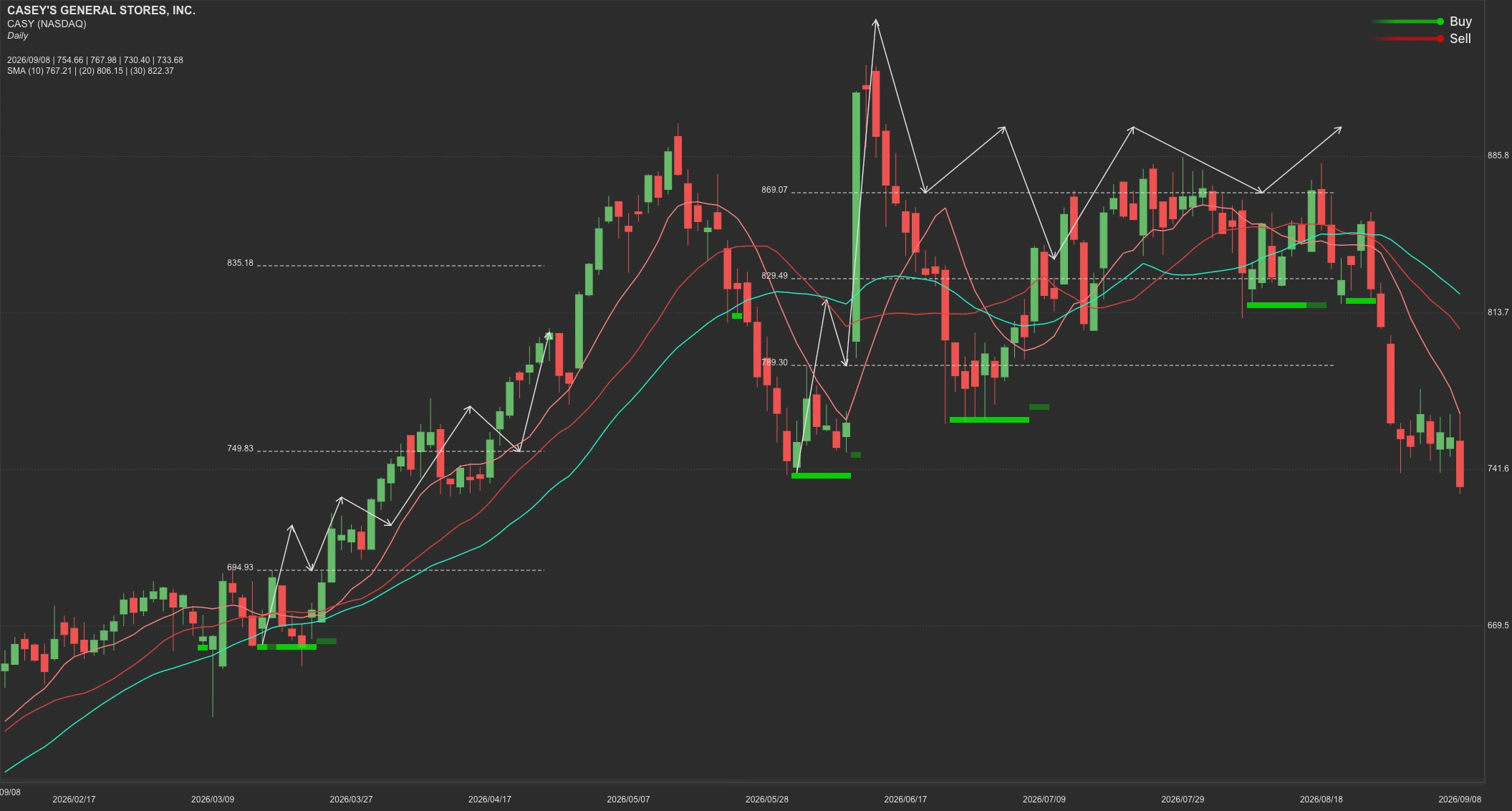
From a stock-price perspective, $785 is currently the key resistance level. If CASY can move above $785 and hold that level, the next important resistance level is around $827.
However, if the price fails to clear $785 and experiences a pullback, it is expected to seek primary support at $657. A breakdown below this baseline would point toward deeper support between $609 and $565.